

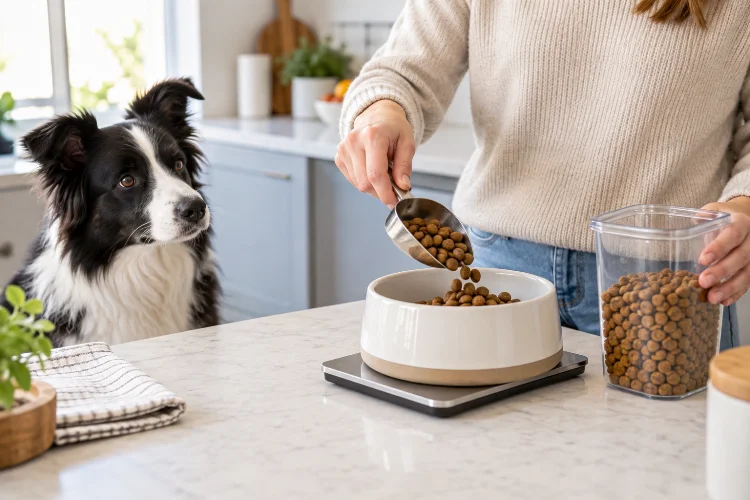
Feeding a dog sounds simple: scoop some food into a bowl and let them eat. Then you look at the feeding chart on the bag, compare it with another brand, notice that the recommendations are completely different, and suddenly dinner feels like a maths problem.
So, how much food should you feed your dog? There is no single portion that works for every pet. A 20-kilogram young Border Collie running for hours every day may need considerably more energy than a 20-kilogram senior dog that prefers sleeping on the sofa.
Age, current weight, ideal weight, activity level, neuter status, health, and even the calorie density of the food all matter. Veterinary nutrition guidance also treats package feeding instructions as a starting point rather than a guaranteed perfect portion.
The goal is therefore not to find one magical number. It is to establish a sensible starting portion, monitor your dog’s body condition, and adjust gradually when necessary.
Start With the Feeding Guide on the Dog Food
The easiest place to begin is the feeding chart printed on your dog’s food packaging.
Commercial dog foods provide feeding recommendations, usually based on body weight. The label should also provide calorie information, which allows you to compare foods that may look similar but contain very different amounts of energy per cup, can, or gram.
However, feeding guides are general recommendations.
If one brand recommends two cups per day and another suggests three, that does not necessarily mean the second brand is more generous. The foods may simply contain different numbers of calories per cup.
Start near the recommended amount for your dog’s size and life stage, then watch what happens to body weight and condition over the following weeks.
Your Dog’s Weight Is Only Part of the Equation
Two dogs can weigh exactly the same and still require different daily portions.
Age, activity, breed, environment, reproductive status, and individual metabolism can significantly change calorie requirements. Merck Veterinary Manual notes that dogs of the same weight can need around 30% more or less energy than another dog of comparable size.
That is why feeding purely according to kilograms or pounds can be misleading.
An active working dog may burn far more calories than a household pet of identical size. Likewise, neutered, obesity-prone, or relatively inactive dogs may require less energy.
Your dog’s lifestyle matters just as much as the number on the scale.
Puppies, Adults, and Seniors Have Different Needs
Life stage makes a major difference.
Puppies need enough energy and nutrients to support growth, but feeding too much is not automatically better. This is particularly important with large and giant breeds, where controlled growth and an appropriate puppy diet help support healthy skeletal development.
Healthy adult dogs generally require fewer calories relative to body size than growing puppies. Their feeding goal shifts from supporting rapid development to maintaining an ideal weight and body condition.
Senior dogs are more complicated.
Some older dogs become less active and need fewer calories, while others lose weight or muscle because of age-related changes or disease.
AAHA recommends monitoring both body condition and muscle condition because weight alone does not provide the full picture in senior pets.
So, do not automatically reduce food simply because your dog has reached a certain birthday.
Learn to Check Your Dog’s Body Condition
Your dog’s shape can tell you more than the feeding chart.
Veterinarians commonly use a Body Condition Score, or BCS, to estimate whether a dog is underweight, at an ideal condition, overweight, or obese. A common system uses a nine-point scale, with an ideal dog generally around 4–5 out of 9.
At a healthy body condition, you should generally be able to feel the ribs easily without having to push through a thick layer of fat. Viewed from above, there should also be a visible waist behind the ribs, while the abdomen should tuck upward when viewed from the side.
If the ribs are difficult to feel and the waist has disappeared, your dog’s daily porton may be too generous.
If ribs, spine, or pelvic bones are excessively prominent, the dog may need more calories or veterinary investigation.
Changes should be gradual rather than dramatic.
Calories Matter More Than Cups
A cup is a measurement of volume, not nutrition.
One dry food might contain 320 calories per cup while another contains 450. Feeding two cups of each would produce very different calorie intakes.
This is why checking the kcal per cup, can, or kilogram on the packaging can be useful. Merck notes that pet food labels include metabolizable energy information so owners and veterinary professionals can understand how much energy the food provides.
Veterinarians can also estimate a dog’s resting energy requirement and then adjust it according to factors such as age, activity, neuter status, or weight goals.
These calculations are not perfect. Merck specifically describes calculated calorie requirements as a starting point that should be modified according to how the individual animal responds.
For everyday owners, that means you do not necessarily need to become a canine nutrition mathematician. Measure what you feed, track your dog’s weight and condition, and adjust with veterinary guidance.
How Often Should Adult Dogs Eat?
For most healthy adult dogs, portion-controlled meals work better than keeping the bowl permanently full.
Merck recommends premeasured meals at regular times as a useful feeding strategy for preventing obesity in many adult dogs, with two meals per day being a common routine.
For example, if your dog’s appropriate daily allowance is 300 grams, you might offer approximately 150 grams in the morning and 150 grams in the evening.
Dividing food into meals can also make appetite changes easier to notice.
If a dog that normally finishes breakfast enthusiastically suddenly refuses it several days in a row, that behavioural change is much more obvious than it might be when food is available all day.
Some dogs with particular medical conditions may require different schedules, so veterinary instructions should take priority.
Do Not Forget About Treats
One of the biggest feeding mistakes happens outside the food bowl.
A dog may receive the perfect amount at breakfast and dinner but still gain weight because nobody counted biscuits, dental chews, pieces of cheese, training rewards, or leftovers from the dinner table.
WSAVA and AAHA recommend keeping treats and other extras to no more than about 10% of total daily calories, leaving at least 90% for a complete and balanced main diet.
For a small dog, those treat calories disappear surprisingly quickly.
If you train your dog several times daily, consider using some of their regular kibble as rewards. You can measure the complete daily food allowance in the morning, then take training rewards from that amount.
This makes calorie control much easier without eliminating treats completely.
Measuring Food Accurately Makes a Difference
Eyeballing portions is convenient but surprisingly inconsistent.
One person’s “cup” may be another person’s overflowing mug. Small differences repeated twice every day can eventually add up to substantial extra calories.
Use the measuring cup recommended for the food or, for greater accuracy, weigh dry food with a simple kitchen scale.
This is especially useful for small dogs, where an extra handful may represent a significant percentage of daily energy intake.
If several people feed the dog, create one system everyone follows. Otherwise, your dog may successfully convince three different family members that nobody has fed them yet.
Dogs can be remarkably persuasive about this.
What If Your Dog Is Gaining Too Much Weight?
Gradual weight gain is easy to miss because you see your dog every day.
AAHA suggests monitoring body condition alongside regular weigh-ins. Warning signs include ribs becoming harder to feel, loss of a visible waist, a rounded abdomen, and reduced stamina during physical activity.
Do not simply cut the dog’s food dramatically.
A veterinarian can confirm whether your pet is actually overweight and help establish an appropriate calorie target. An unexplained change in body weight can also sometimes indicate an underlying health condition rather than a simple feeding problem.
Successful weight management usually involves controlled calories, appropriate activity, accurate measurement, and consistency from everyone in the household.
The occasional extra snack may look harmless, but repeated every day it becomes part of the diet.
When Should You Adjust Your Dog’s Food?
Feeding amounts are not supposed to remain identical throughout a dog’s entire life.
Review portions after major lifestyle changes. Neutering, aging, illness, reduced exercise, a move from working life to retirement, or a change to a more calorie-dense food may all affect energy needs.
You should also reassess portions if your dog’s weight begins moving steadily upward or downward.
AAHA recommends nutritional assessment throughout a dog’s life, including consideration of body weight, body condition, muscle condition, diet, activity, and health.
Avoid making several major diet changes simultaneously. Gradual adjustments make it easier to see what is actually working and may reduce digestive upset when changing foods.
For dogs with diabetes, kidney disease, gastrointestinal disorders, obesity, food sensitivities, or other medical conditions, follow a veterinarian’s individual recomendation rather than a generic online feeding guide.
Common Feeding Mistakes to Avoid
Overfeeding is not always obvious.
Extra treats, inaccurate measuring, unrestricted access to food, and forgetting that several family members give snacks can quietly increase calorie intake.
Another mistake is assuming a dog asking for food must genuinely need more calories. Some dogs will enthusiastically request another dinner five minutes after finishing the first one.
Begging behaviour is not a reliable body-condition assessment.
Changing food too frequently can also make feeding harder to manage. Different products vary in calorie density, so using the same scoop after switching foods can accidentally increase or decrease your dog’s daily intake.
Check the label whenever the diet changes, even if the new food looks very similar to the old one.
So, how much food should you feed your dog? Start with the manufacturer’s feeding guide, but treat it as a starting point rather than an absolute rule.
Your dog’s age, ideal weight, activity level, neuter status, health, calorie requirements, and body condition all influence the right amount.
Measure meals consistently, check calorie density, and remember that treats count toward the daily total. Most importantly, watch the dog in front of you rather than relying entirely on a number printed on a bag.
Check weight and body condition regularly and discuss unexpected changes with your veterinarian.
With a little measuring and occasional adjustment, you can build a feeding routine that supports a healthy weight without turning every dinner into a complicated nutrition project.