

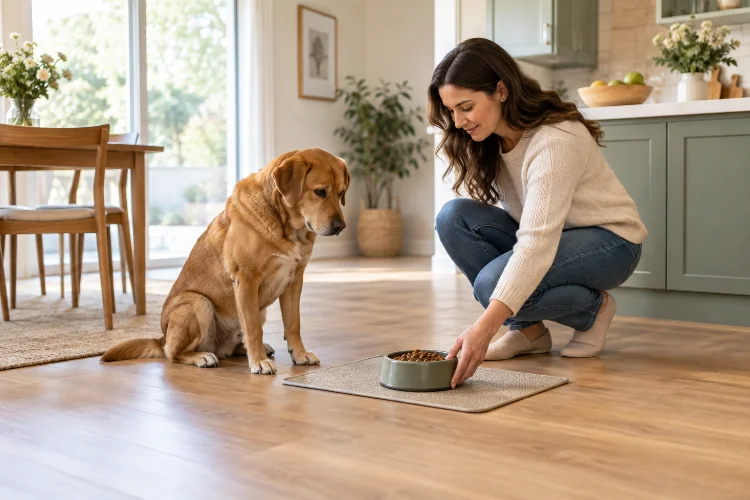
Feeding an adult dog should be one of the easiest parts of pet ownership. Put food in a bowl, let your dog eat, and you are done.
Except, once you start looking for advice, you will find recommendations ranging from one large meal a day to three or even more smaller meals.
So, how often should adult dogs be fed? For many healthy adult dogs, two measured meals per day – usually morning and evening – is a practical starting point.
Veterinary sources commonly recommend regular portion-controlled meals, while some healthy dogs can also do well eating once daily. Individual needs still matter.
Meal frequency is only one part of the picture. Your dog’s total daily calories, activity, body condition, age, health, and the type of food they eat are just as important.
Instead of searching for one perfect rule for every dog, it is more useful to understand why feeding schedules differ and how to build one that works for your own pet.
Is Twice a Day Best for Most Adult Dogs?
For most household dogs, breakfast and dinner is a simple and effective routine.
VCA Animal Hospitals recommends at least two meals per day for many dogs, noting that regular meals provide predictability and divide daily food intake into manageable portions.
Merck Veterinary Manual similarly describes two premeasured meals at regular times as a useful feeding approach for adult dogs, particularly for controlling calorie intake.
For example, if your dog needs 300 grams of food per day, you might offer around 150 grams in the morning and 150 grams in the evening.
The exact clock time is less important than consistency. Feeding at roughly 7 a.m. and 6 p.m., for example, is perfectly reasonable if it fits your household routine.
Dogs tend to appreciate predictable schedules, and regular mealtimes can make changes in appetite easier to notice.
Can Adult Dogs Eat Once a Day?
Some healthy adult dogs can manage one daily meal.
Merck Veterinary Manual states that most adults can generally be fed one to two times per day. However, other veterinary guidance commonly favours dividing food into at least two meals for routine household feeding.
Once-daily feeding has also attracted attention because observational research has explored possible associations between meal frequency and health.
However, researchers and veterinary experts have cautioned against changing a dog’s feeding routine solely because of preliminary findings.
In practical terms, there is rarely a need to force a healthy dog that is doing well on two daily meals to switch to one.
Dogs that become extremely hungry, vomit bile when their stomach stays empty too long, or have certain gastrointestinal conditions may actually benefit from more frequent meals rather than fewer.
Some Dogs May Need Three or More Small Meals
Two meals is a useful starting point, but it is not a universal law.
VCA notes that some dogs do better with a third meal or bedtime snack, including dogs that can only comfortably consume small amounts at one time or those with conditions such as gastroesophageal reflux.
Small dogs may also find several modest meals easier than one very large serving.
Working and highly active dogs can have higher calorie requirements as well. Instead of placing a huge quantity of food into one bowl, dividing the same daily calories into multiple servings may be more practical.
Medical conditions can change meal frequecy too. Dogs receiving insulin, certain medications, or therapeutic diets may need food at carefully controlled times.
When a veterinarian provides a specific feeding schedule, that individual medical plan should take priority over general feeding advice.
Meal Frequency Is Different From Portion Size
A common mistake is adding meals without adjusting the total amount of food.
If your dog requires 600 calories per day, changing from two meals to three does not automatically mean they need another 300-calorie meal. The same 600 calories should normally be divided across the new schedule.
This distinction is essential for maintaining a healthy weight.
Pet food labels provide feeding recommendations and calorie information, but Merck Veterinary Manual describes label feeding guidelines as general starting points. Owners still need to monitor body weight and body condition because individual requirements vary.
A dog that eats twice daily can still become overweight if each meal is too large.
Likewise, a dog eating three times per day can maintain an ideal body condition if the total daily calories are appropriate.
Think about the entire day’s food rather than focusing only on what appears in one bowl.
Scheduled Meals Are Usually Better Than Free Feeding
Free feeding means leaving food available all day so the dog can eat whenever they want.
It sounds convenient, particularly for busy owners. The problem is that many dogs are not especially talented at controlling their own calorie intake.
Merck recommends portion-controlled feeding for most adult dogs because unrestricted access can contribute to obesity. AAHA similarly warns that free feeding may encourage overeating and makes portion control more difficult.
Scheduled meals also make appetite easier to monitor.
Imagine your dog normally empties breakfast within five minutes. One morning they suddenly leave most of the bowl untouched. Because you know their normal eating pattern, the change becomes immediately obvious.
That information can be valuable because reduced appetite sometimes accompanies illness.
Free feeding also becomes complicated in multi-dog households, where one dog may quietly eat another dog’s share.
Body Condition Matters More Than Begging
Dogs are extremely convincing when food is involved.
Your dog may stare at the refrigerator immediately after dinner as though nobody has fed them for several weeks. That does not necessarily mean the portion was inadequate.
Body condition is a much better guide.
AAHA describes a body condition score of around 4–5 on a nine-point scale as ideal for most dogs. At an appropriate weight, the ribs should generally be easy to feel without excessive fat covering, and a visible waist should be present when the dog is viewed from above.
If your dog’s waist gradually disappears and the ribs become difficult to feel, the total calorie intake may be too high.
Weight loss also deserves attention. An adult dog losing weight despite eating normally may have increased energy requirements or an underlying health issue.
Instead of responding automatically to begging by adding another meal, monitor weight and body condition and adjust portions when there is a genuine reason.
Do Treats Count as Another Meal?
Nutritionally, they certainly count toward the day’s calories.
A biscuit after breakfast, training rewards during a walk, a dental chew in the afternoon, and some chicken from dinner can quietly become a significant part of the dog’s total intake.
The World Small Animal Veterinary Association recommends keeping treats to no more than around 10% of a healthy dog’s daily calorie intake. AAHA gives similar guidance.
That means at least roughly 90% of daily calories should usually come from a complete and balanced diet.
A useful trick is to reserve some of your dog’s regular kibble for training. Instead of adding extra calories, take rewards from the amount they were already supposed to eat that day.
This can be especially helpful for small dogs, where a few calorie-dense treats may represent a surprisingly large proportion of their daily needs.
Large Dogs May Benefit From Divided Meals
Giving a large dog one enormous meal simply because they are physically capable of eating it is not always ideal.
Merck specifically recommends feeding large-breed dogs smaller meals at least twice daily rather than concentrating everything into one serving.
For owners of larger dogs, dividing food is also more comfortable and convenient. Instead of placing an enormous amount of kibble into the bowl at once, the daily allowance can be split between morning and evening.
Breed, body shape, digestive health, and activity may influence the best routine, so owners of giant or deep-chested breeds can discuss meal size and other feeding precautions with their veterinarian.
Whatever schedule you use, avoid randomly increasing food simply because the dog is large. Portion requirements should reflect calories and ideal body condition rather than bowl size.
Should Senior Dogs Have a Different Feeding Schedule?
Becoming a senior does not automatically mean a dog needs more or fewer meals.
Some older dogs remain active and maintain essentially the same routine for years. Others develop dental problems, reduced appetite, digestive changes, chronic disease, or medications that make smaller, more frequent meals easier.
A senior dog that suddenly changes eating habits should not simply be dismissed as “getting old.”
Merck recommends at least annual veterinary examinations for adult dogs and more frequent examinations for seniors, partly because illnesses become more common with age.
If your older dog starts refusing meals, losing weight, drinking unusually large amounts of water, vomiting, or struggling to chew, arrange a veterinary check rather than merely changing the feeding schedule.
Their diet and routine may need adjusting, but it is important to understand why first.
How to Build a Simple Adult Dog Feeding Routine
For a healthy adult dog without special dietary requirements, you can keep things simple.
Calculate or establish the appropriate total daily amount of food, then divide that quantity between two meals. Feed at approximately the same times each day and provide fresh drinking water.
Measure portions instead of estimating them by eye. AAHA notes that inaccurate portioning can contribute to overfeeding, so a proper measuring cup – or even a kitchen scale – can make everyday feeding more consistent.
Remember to include treats, chews, toppers, and table food when thinking about the total day’s calories.
Then monitor the result.
If your dog maintains a healthy weight, has normal energy, produces normal stools, and seems comfortable between meals, there may be no reason to change the routine.
Review the amount and schedule when activity, age, health, medication, or body weight changes.
When Should You Talk to Your Veterinarian?
Most feeding adjustments are straightforward, but some changes deserve professional guidance.
Speak with your veterinarian if your dog suddenly becomes extremely hungry, refuses meals repeatedly, gains or loses significant weight, vomits frequently, develops chronic diarrhea, or seems uncomfortable after eating.
Medical conditions such as diabetes and gastrointestinal disease can require carefully timed meals. VCA notes that established feeding schedules can be particularly helpful when medication must be coordinated with food.
Your veterinarian can also help calculate an appropriate calorie target rather than relying entirely on a generic feeding-chart recomendation.
This is particularly useful for underweight dogs, overweight pets, highly active working dogs, seniors, or animals receiving prescription diets.
So, how often should adult dogs be fed? For many healthy adults, two portion-controlled meals per day is a practical and widely recommended routine.
Some dogs can comfortably eat once daily, while others may benefit from three smaller servings because of their size, lifestyle, digestive comfort, or medical needs.
More important than chasing the perfect number of meals is controlling total daily calories. Measure portions, count treats, monitor body condition, and keep the schedule reasonably consistent.
Start with morning and evening meals if your dog has no special requirements, then watch how they respond. If appetite, weight, digestion, or health changes noticeably, discuss the routine with your veterinarian rather than simply adding or removing meals.