

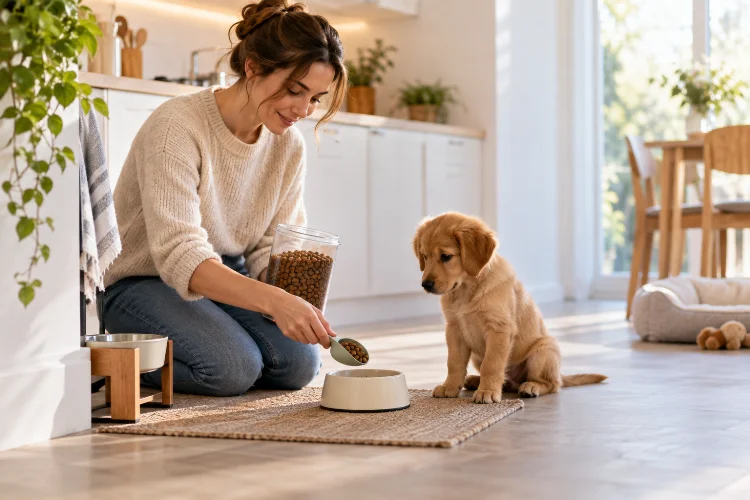
Bringing home a puppy usually comes with plenty of questions. How much should they sleep? Why are they chewing everything? And perhaps one of the most important questions: how often should you feed a puppy?
Unlike most adult dogs, young puppies cannot simply eat one big meal and comfortably wait until the next day.
They are growing quickly, have relatively small stomachs, and need enough energy and nutrients to support developing muscles, bones, organs, and brains. That usually means several smaller meals spread throughout the day.
The exact feeding schedule depends on your puppy’s age, size, breed, body condition, food, and individual health needs. Veterinary guidance commonly recommends three to four daily meals for young puppies, gradually reducing the frequency as they mature.
The good news is that puppy feeding does not need to be complicated. Once you understand a few basic principles, creating a consistent routine becomes surprisingly easy.
How Many Times a Day Should a Puppy Eat?
Young puppies generally need more frequent meals than older puppies because they have small stomachs but relatively high energy requirements.
A useful general guideline is:
6-12 weeks: around four meals per day
3-6 months: around three meals per day
6-12 months: usually two meals per day
After maturity: most dogs continue with two meals daily
The American Kennel Club recommends four daily feedings during roughly the 6-to-12-week stage, dropping to three meals between three and six months and generally two meals from six months onward.
These numbers are guidelines rather than strict rules. Breed size, metabolism, health, and the specific puppy food you use can change the ideal schedual.
Feeding Puppies From 6 to 12 Weeks
The first few months are an intense period of growth. Once a puppy has been weaned, it should normally eat a complete and balanced food specifically formulated for puppies rather than standard adult dog food.
At this age, four smaller meals spread across the day can make it easier for the puppy to consume enough nutrients without overwhelming a small stomach. VCA Animal Hospitals similarly recommends four measured meals daily for puppies around five to twelve weeks old.
For example, meals could be offered around breakfast, late morning or lunchtime, late afternoon, and early evening.
Consistency matters more than hitting an exact minute. Feeding at roughly predictable times can also make house training easier because puppies commonly need a toilet break shortly after eating.
Feeding Puppies From 3 to 6 Months
As your puppy grows, their stomach becomes capable of handling larger meals. Somewhere during this period, most puppies can move from four meals to three.
Breakfast, lunch, and dinner is often the easiest routine for owners to remember.
Do not simply increase every meal while keeping four large meals per day, though. Your puppy’s daily calorie requirement should be divided across the number of meals rather than added on top of each feeding.
This is also a good time to begin paying attention to body condition. A healthy growing puppy should not automatically be as round as possible. Overfeeding can encourage excessive weight gain and unnecessarily rapid growth.
Your veterinarian can help determine whether your puppy is developing at an appropriate rate.
Feeding Puppies From 6 to 12 Months
Many puppies can transition to two meals per day at around six months.
A morning meal and an evening meal is a simple routine that also works well for many adult dogs. The AKC recommends beginning twice-daily feeding during the six-to-twelve-month period.
However, maturity does not occur at exactly the same age for every dog.
Small breeds generally mature more quickly, while large and giant breeds can continue developing for considerably longer. Some large dogs may remain on puppy or growth formulas past their first birthday, depending on their breed and veterinarian’s recommendation.
So while meal frequency may drop to twice daily, that does not necessarily mean it is time to switch immediately to adult food.
Toy Breeds May Need More Frequent Meals
Very small puppies deserve special attention.
Toy breeds have tiny stomachs and can have difficulty consuming enough food in only a few large servings. Some very young toy-breed puppies are also more vulnerable to low blood sugar, particularly when they go too long without eating.
The AKC notes that toy-breed puppies may require four to six meals per day during their earliest months, with feeding frequency gradually reduced as they mature.
This means a Chihuahua puppy and a Labrador puppy of the same age may not follow exactly the same feeding routine.
If you own a very small breed, ask your veterinarian for a specific feeding plan rather than relying entirely on a generic chart.
Large-Breed Puppies Need Controlled Growth
Large and giant puppies have another challenge: growing at the right speed.
It may seem logical to feed a large-breed puppy as much as possible so it becomes big and strong. In reality, excessively rapid growth can place unnecessary pressure on developing bones and joints.
VCA notes that controlled energy intake during growth is especially important for large-breed puppies. Measured portions and appropriate growth rates can help support healthier musculoskeletal development.
Choose puppy food designed for the expected adult size of your dog when appropriate. Large-breed puppy formulas are designed with their particular nutritional requirements in mind.
The goal is steady, healthy development – not maximum growth as quickly as possible.
How Much Food Should You Give at Each Meal?
Feeding frequency answers only half the question. Portion size matters just as much.
Start with the feeding guide printed on your puppy food packaging. These charts usually estimate daily amounts according to factors such as age, weight, or expected adult size.
Then divide the total daily amount by the number of meals.
If the food recommends 300 grams per day and your puppy eats three times daily, for example, each meal would be approximately 100 grams.
Packaging instructions are still only a starting point. Individual metabolism, exercise level, breed, neuter status, growth rate, and body condition can affect actual calorie requirements.
The AKC recommends paying attention to the puppy’s body condition rather than focusing exclusively on what remains in the bowl.
A veterinarian can provide more precise advice if your puppy appears unusually thin or gains weight too quickly.
Should Puppies Have Food Available All Day?
Leaving a permanently full bowl on the floor may seem convenient, but unrestricted feeding is not usually the best strategy.
Scheduled meals make it easier to measure exactly how much your puppy consumes. They also help establish a predictable toilet routine and allow you to notice changes in appetite more quickly.
VCA advises against unlimited free-choice feeding for puppies because overeating can contribute to excessive weight gain and encourage unhealthy eating habits.
Meal feeding also helps with training. Your puppy learns that food arrives at predictable times rather than being continuously available.
That does not mean you should restrict drinking water. Puppies should normally have regular access to fresh, clean water unless your veterinarian gives different instructions for a medical reason.
Do Treats Count as Part of a Puppy’s Diet?
Yes—and this is something new owners can easily forget.
Those tiny training rewards may look insignificant, but twenty or thirty treats throughout the day can add a surprising number of calories.
VCA recommends that treats and snacks make up no more than about 10% of a puppy’s total daily calories so that most of their nutriton comes from a complete and balanced diet.
When training frequently, consider using tiny treats or reserving part of your puppy’s normal food allowance for rewards.
For example, instead of adding an extra handful of treats during a training session, you can take some kibble from the puppy’s measured daily portion.
Why a Regular Feeding Routine Helps With Potty Training
Food goes in, and fairly predictably, something eventually needs to come out.
That simple biological reality makes feeding schedules useful during house training.
VCA notes that puppies commonly need to relieve themselves within roughly 10 to 15 minutes after eating. A predictable meal schedule therefore gives owners a better idea of when to take the puppy outside.
Try combining meals with a routine: feed your puppy, allow a short period to finish, then provide an opportunity to go outside.
Over time, predictable meals, toilet breaks, play sessions, and sleep periods can make life much easier for both puppy and owner.
When Should You Change the Feeding Schedule?
Do not change meal frequency simply because the calendar says your puppy reached a particular age yesterday.
Watch the individual dog.
Some puppies naturally become less interested in one meal as they mature. The VCA notes that repeatedly showing less hunger at a particular meal can indicate that a puppy may be ready to drop that feeding.
Changes should still be gradual. Suddenly changing food, portion size, and meal frequency at the same time may make it harder to identify the cause if digestive problems appear.
Also pay attention to appetite. Puppies can occassionally be distracted or less interested in a meal, but persistent refusal to eat – especially when accompanied by vomiting, diarrhoea, weakness, or unusual behaviour – deserves veterinary attention.
What About Puppies Younger Than Eight Weeks?
Very young puppies are a different situation.
Before normal weaning, puppies should generally receive nutrition from their mother. Orphaned puppies that require bottle feeding have very different nutritional and feeding-frequency requirements from weaned puppies.
VCA notes that orphaned newborn puppies may need feeding every two to four hours during their first week. Bottle or tube feeding also carries risks when performed incorrectly, including aspiration into the lungs.
If you are caring for an orphaned or unusually young puppy, veterinary guidance is strongly recomended rather than following a standard schedule intended for weaned pets.
So, how often should you feed a puppy? Most young puppies need three to four small meals each day, with many gradually transitioning to two meals around six months of age.
Very small toy breeds may need more frequent meals, while large breeds require particularly careful portion control to support steady growth.
The number of meals is only part of good puppy nutrition. Choose an age-appropriate complete diet, measure portions, keep treats under control, provide fresh water, and monitor your puppy’s weight and body condition as they grow.
Start with the feeding recommendations on your puppy food, create a consistent daily routine, and discuss adjustments with your veterinarian. A simple feeding schedule now can help establish healthy eating habits that last into adulthood.