
Bringing home a puppy is exciting right up until you discover that your new four-legged friend believes electrical cables, shoes, houseplants, rubbish bins, and remote controls are all potential toys.
Puppies explore their surroundings with enormous curiosity, and much of that exploration happens with their mouths. Something that looks completely harmless to you can become a choking, poisoning, falling, or electrical hazard within seconds.
The American Kennel Club recommends looking at your home from a puppy’s level because hazards near the floor are particularly easy to overlook.
Learning how to puppy-proof your home and garden before your puppy arrives can prevent accidents while making training much easier. You do not need to transform your home into an empty room, either.
The goal is simply to remove unnecessary risks, control access to dangerous areas, and create safe spaces where your puppy can explore.
Here is where to start.
Start by Seeing Your Home From a Puppy’s Perspective
One surprisingly effective puppy-proofing technique is to literally get down near floor level and look around.
You may suddenly notice cables hanging behind a television, children’s toys under the sofa, loose coins near a table, shoes beside the door, or a low shelf filled with objects small enough to swallow.
Puppies are remarkably good at discovering things humans stopped noticing months ago.
The AKC recommends limiting a young puppy’s access rather than immediately allowing it to roam throughout the entire house. Baby gates, exercise pens, closed doors, and puppy-safe rooms make supervision much easier.
As your puppy learns household rules, you can gradually provide more freedom.
Secure Electrical Cables and Small Objects
Electrical cables deserve immediate attention. A puppy chewing through a powered cable risks burns or electric shock, so move cords behind furniture, use cable covers, or secure them somewhere your dog cannot reach.
Do not forget charging cables, extension cords, headphones, and wires underneath desks. Dangling blind and curtain cords can also present risks and should be tied securely out of reach.
Small household objects are another common problem. Coins, batteries, jewellery, rubber bands, hair ties, children’s toys, paper clips, and pieces of plastic can be swallowed accidently. The ASPCA advises keeping small objects and loose cords away from curious young pets.
A simple rule works well: if an object fits inside your puppy’s mouth, assume it may eventually end up there.
Make the Kitchen and Bathroom Puppy-Safe
Kitchens can be surprisingly dangerous for dogs. Food smells make rubbish bins especially tempting, while cupboards may contain cleaning products, plastic packaging, sharp utensils, and foods that are unsafe for pets.
Use a secure rubbish bin with a lid and keep cleaning chemicals inside locked or inaccessible cabnets. The AKC recommends storing products such as bleach, bathroom cleaners, detergent, and fabric softener where puppies cannot reach them.
Human food also requires attention. Chocolate, grapes, raisins, onions, certain sugar-free products containing xylitol, and other foods can be dangerous to dogs.
Bathrooms have similar risks. Keep medicines securely stored, close toilet lids, remove razors and cleaning products, and avoid leaving pills on counters or bedside tables where a growing puppy may eventually reach them.
Check Your Houseplants Before Your Puppy Arrives
That beautiful indoor plant in the corner may become much more interesting once a curious puppy enters the house.
Some plants can cause gastrointestinal irritation or more serious poisoning when eaten. The ASPCA recommends checking whether existing houseplants are toxic and either removing dangerous varieties or placing them somewhere pets genuinely cannot access.
Do not assume a high table will permanently solve the problem. Puppies grow quickly, and a plant that was unreachable at ten weeks may become accessible a few months later.
The same principle applies outside. Check the flowers, shrubs, bulbs, mushrooms, and other vegetation growing anywhere your puppy can explore.
Create a Safe Space for Rest and Training
Puppy-proofing is not only about removing dangerous things. Your dog also needs somewhere that feels secure.
This could be a crate, puppy pen, bed, or quiet corner of a puppy-safe room. PDSA recommends giving dogs a comfortable safe place where they can relax without being constantly disturbed.
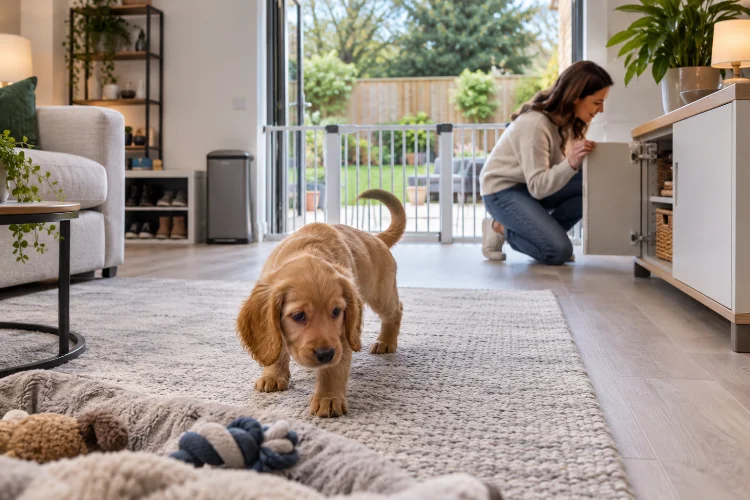
Baby gates can be especially useful during the first few months. They allow you to separate your puppy from kitchens, stairs, children’s play areas, or rooms containing valuable items without isolating the dog completely.
PDSA also notes that consistent boundaries are important. Allowing your puppy into a room one day and punishing them for entering it the next can create unnecessary confusion.
Puppy-Proof Your Garden Fence
Your garden may look secure until you imagine being a small dog determined to investigate the world on the other side.
Walk around the entire boundary and look for gaps beneath fences, loose boards, damaged gates, or holes a small puppy could squeeze through. Remember that puppies can also dig, so check areas where the bottom of a fence leaves exposed soil.
PDSA advises ensuring there is nowhere a puppy can squeeze through or dig beneath a garden boundary.
Check gates every time you use them, especially when other people regularly enter the property. Delivery workers, children, contractors, or visiting relatives may not automatically realise that a puppy is loose in the garden.
Even with good fencing, young puppies benefit from close supervison outdoors.
Remove Chemicals, Tools, and Other Garden Hazards
A garden shed can contain an impressive collection of things a puppy should never investigate.
Fertiliser, weed killer, insecticides, rodent poison, fuel, paint, sharp gardening equipment, and other chemicals should be securely stored. Never leave open bags or containers somewhere your dog can reach them.
The AKC advises keeping puppies away from areas recently treated with fertilisers, pesticides, or insecticides and following product instructions before allowing dogs back onto treated ground.
Mulch deserves attention as well. Cocoa mulch, for example, can be harmful to dogs when eaten.
Pools and ponds also need careful management. A secure barrier around a swimming pool can prevent a curious puppy from falling into the water when nobody is close enough to help.
Keep Dangerous Foods, Medicines, and Chemicals Out of Reach
Storage is one of the easiest ways to prevent puppy emergencies.
Medications should remain inside enclosed cupboards rather than on nightstands or countertops. Cleaning supplies should be locked away, while food should be stored in sealed containers or cupboards that your puppy cannot open.
Remember that puppies grow surprisingly quickly. Today’s inaccessible kitchen counter may become tomorrow’s snack buffet.
If you believe your puppy has eaten something potenially toxic, do not simply wait for symptoms to appear.
Contact a veterinarian or appropriate animal poison service promptly for professional guidance. The ASPCA recommends immediate veterinary or poison-control advice when toxic exposure is suspected.
Do Not Forget Heat, Shade, and Outdoor Supervision
A secure garden is not automatically a safe place to leave a puppy for unlimited periods.
Weather conditions matter. During hot days, dogs need access to fresh water, shade, and cooler areas. The AKC advises being cautious about heat and ensuring dogs have shade and cool water outdoors.
Young puppies also need supervision because they may chew plants, dig around fencing, investigate insects, swallow stones, or find objects you missed during your initial safety inspection.
Gardens change too. New plants appear, storms damage fencing, tools get left outside, and lawn treatments are applied. Puppy-proofing should therefore be an ongoing habit rather than something you do only once before bringing your dog home.
Puppy-Proofing Should Grow With Your Dog
One of the easiest mistakes is assuming that a home that was safe for an eight-week-old puppy will automatically remain safe six months later.
As puppies grow, they become taller, stronger, faster, and considerably better at reaching tables, counters, shelves, and door handles. The ASPCA specifically notes that young pets may eventually reach areas that were previously inaccessible.
Review your setup every few weeks. Check whether your puppy can now reach countertops, push through gates, jump onto furniture, or access plants and objects that once seemed safely out of range.
Training should develop alongside these environmental precautions. Teaching commands such as “leave it,” “drop it,” and a reliable recall gives you another layer of protection when curiosity wins.
Learning how to puppy-proof your home and garden is mostly about thinking ahead.
Secure electrical cords, medicines, chemicals, rubbish bins, small objects, toxic plants, garden products, pools, and escape routes before your puppy gets the opportunity to investigate them.
At the same time, create a comfortable safe space and use gates or pens to control access while your puppy learns household rules. Remember that safety arrangements will need updating as your dog grows taller, stronger, and more adventurous.
Before your new puppy arrives, spend 20 minutes walking through every room and around the entire garden from their perspective. Fixing a loose fence board or moving a bottle of cleaner today is far easier than dealing with an emergency tomorrow.