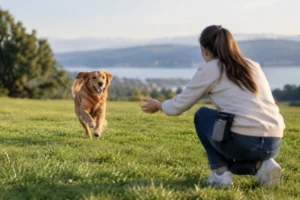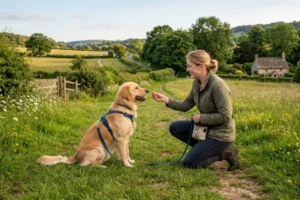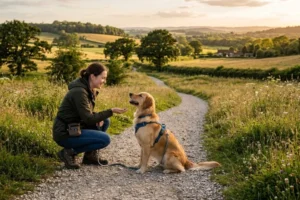

Teaching your dog to stay sounds simple until you take one step backwards and your dog immediately follows you like a furry shadow. If that happens, do not worry. Staying still while their favourite human walks away is actually a fairly complicated skill for a dog to learn.
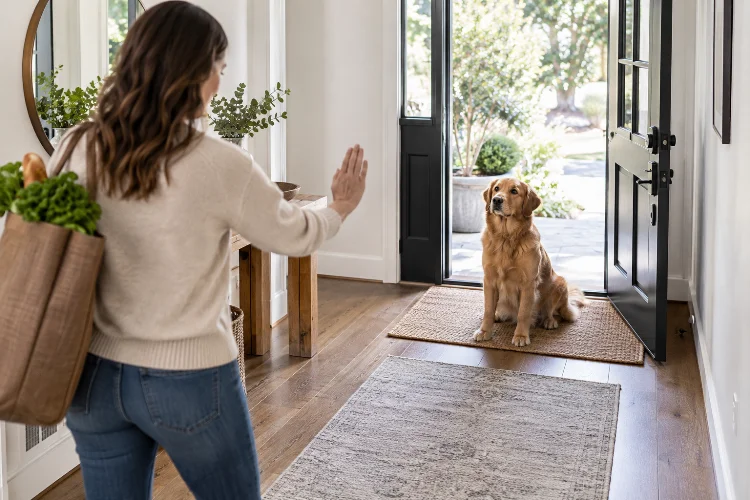
Knowing how to teach a dog to stay is useful far beyond basic obedience. A reliable stay can help your dog wait while you open the front door, remain safely in position while someone carries groceries inside, settle during visitors, or pause before crossing a road.
The key is not expecting too much too quickly. The American Kennel Club describes stay as a duration behaviour: the dog learns to remain in position until a separate release cue tells them the exercise has finished.
With short sessions, good rewards, and gradual progress, puppies and adult dogs can both learn the skill. You simply need to break it into manageable pieces.
Understand What “Stay” Actually Means
Before training begins, decide exactly what you want the cue to mean.
For most owners, “stay” means: remain in your current position until I tell you that you are free to move. That last part is important because your dog needs to understand not only when the behaviour begins, but also when it ends.
This is where a release cue becomes useful.
Choose a short word such as “free,” “okay,” or “all done.” The exact word does not matter as much as consistancy.
The AKC recommends teaching the release word before adding longer stays. Once the dog understands that the release cue means they can move, the stay itself becomes much clearer.
Start With a Sit or Down
Stay is easier when your dog already understands a stationary behaviour such as “sit” or “down.”
Begin somewhere quiet, ideally indoors where there are few distractions. Ask your dog to sit, then stand calmly in front of them.
Say “stay” once. You can also introduce a hand signal, such as holding an open palm toward the dog.
Wait for just one second.
If your dog remains in position, reward them immediately with a small treat. Then give your release word and encourage them to move.
That is the entire first exercise.
Do not begin by walking across the room or asking for a 30-second stay. At the beginning, success might literally mean remaining still for one second.
Reward-based training helps dogs understand which behaviours are worth repeating. Both the RSPCA and American Veterinary Society of Animal Behavior support reward-based approaches rather than techniques based on force, fear, or punishment.
Build Duration Before You Add Distance
One of the most common training mistakes is changing too many things at once.
If your dog can stay for two seconds while you stand directly in front of them, do not immediately walk ten metres away and expect them to remain there.
First, increase duration.
Ask for a sit, give the stay cue, wait two seconds, reward, and release. Next time, perhaps wait three seconds.
Gradually work toward five, eight, and ten seconds.
Do not increase the duration every single repetition. Mixing easy attempts with slightly harder ones can keep the exercise achievable.
For example, you might practise stays lasting three seconds, five seconds, four seconds, seven seconds, and then three seconds again.
If your dog gets up before the release cue, calmly reset them and make the next repetition easier. The AKC specifically recommends reducing the difficulty when a dog repeatedly breaks position rather than treating the mistake as disobedience.
Add Distance One Step at a Time
Once your dog can remain still for several seconds, you can begin adding distance.
Ask for the stay, take one small step backwards, and immediately return to your dog.
Reward them while they are still in position, then give the release cue.
After several succesful repetitions, try two steps.
One important detail: return to the dog before releasing them during early training. Otherwise, your dog may learn that “stay” means wait until they decide to run toward you.
Gradually increase the distance over multiple sessions.
You can eventually practise turning sideways, briefly turning your back, walking around the dog, or moving several metres away.
Remember that distance makes the exercise harder. If you increase distance, reduce duration temporarily.
A dog that can stay for 30 seconds with you standing beside them may initially manage only a few seconds when you move several steps away.
Introduce Distractions Slowly
Your living room and a busy park are completely different training environments.
A dog may perform an excellent stay at home but suddenly appear to “forget everything” when another dog runs past.
They have not necessarily forgotten the cue. The environment simply became much harder.
Think of training in terms of three variables:
Duration: how long the dog remains still.
Distance: how far away you move.
Distraction: what is happening around the dog.
When introducing a new distaction, make the other two elements easier.
For example, if you start practising outside, stand close to your dog and ask for only a short stay. Once they understand the exercise in that environment, gradually increase difficulty.
Reward quality matters too. The RSPCA notes that more challenging behaviours or distracting environments may require higher-value rewards than familiar exercises at home.
A piece of kibble might work perfectly in your kitchen. Near squirrels, chicken may suddenly become much more persuasive.
Use Positive Reinforcement Instead of Corrections
Stay should not feel like a trap.
If your dog moves too early, avoid shouting, jerking the leash, or physically forcing them back into position.
Instead, reset the exercise and reduce the difficulty.
Positive reinforcement means providing something the dog values after the behaviour you want. That reward could be food, praise, play, or access to something enjoyable. The AKC describes this process as making the rewarded behaviour more likely to occur again.
Timing is particularly important.
Reward while your dog is still staying rather than after they have already stood up and wandered away. The Humane Society notes that reinforcement should occur promptly so the animal can clearly associate the reward with the correct behaviour.
Think of each reward as telling your dog, “Yes, that exact thing you just did is what I wanted.”
Keep Training Sessions Short
Ten minutes of frustrated training is usually less useful than two minutes of enjoyable practce.
Dogs learn better when sessions remain engaging. Puppies in particular may have limited attention spans, so several short sessions throughout the day can work better than one long lesson.
Try practising during normal life.
Ask for a five-second stay before placing the food bowl down. Practise while opening the back door. Ask your dog to remain on a mat while you put on your shoes.
These small repetitions help the behaviour become useful rather than something the dog performs only during formal training.
Training also provides mental stimulation and helps build clearer communication between dogs and their caregivers. The RSPCA recommends ongoing reward-based training as part of responsible dog care.
Always Use a Clear Release Cue
A common mistake is forgetting to tell the dog when the stay has finished.
Imagine someone asking you to wait without ever explaining when you are allowed to leave. Eventually, you would simply make your own decision.
Dogs can do the same thing.
Always finish a successful stay with the same release cue. Say “free,” for example, and encourage the dog to move.
Avoid using “come” as your release every single time.
If every stay ends with your dog running toward you, they may begin anticipating the recall and break position early.
Sometimes release them and walk together. Other times release them toward a toy, food bowl, or another activity.
The goal is for the dog to wait for permission rather than predict what happens next.
What to Do When Your Dog Keeps Breaking the Stay
If your dog repeatedly moves, the exercise is probably too difficult.
Instead of thinking, “My dog is stubborn,” ask which part became harder.
Did you wait too long? Walk too far away? Introduce another dog, visitor, food bowl, or exciting noise too soon?
Return to the last level where your dog was successful.
If they can hold a 10-second stay but repeatedly break at 20 seconds, go back to five or eight seconds for several repetitions before trying again.
Also consider the value of your reward. A distracted dog may simply find the environment more interesting than what you are offering.
The AKC recommends slowing down and making training easier when dogs struggle rather than repeatedly allowing them to fail.
Practise Stay in Real-Life Situations
Once your dog understands the basics, begin using the skill where it actually matters.
You might ask for a stay before opening the front door, while guests enter, before crossing a quiet street, or while putting your dog’s leash on.
A place or mat stay can also be useful during meals. Fear Free Happy Homes recommends rewarding dogs for staying on a designated mat or area instead of allowing them to wander underfoot while people eat or cook.
Safety still matters.
Do not rely on an unfinished stay command beside busy traffic or other dangerous situations. Use a leash or physical barrier whenever failure could put your dog at risk.
Training skills become reliable through repetition across many environments. Being excellent in the kitchen does not automatically mean your dog is ready to perform the same behaviour beside a crowded café.
Common Mistakes When Teaching Stay
The biggest mistake is usually progressing too quickly.
Owners often increase time, distance, and distractions simultaneously, then become confused when the dog fails. Work on one difficulty at a time.
Repeating “stay, stay, stay” can also weaken the cue. Ideally, give the signal once and then reward the dog for maintaining position.
Another problem is calling the dog toward you after every repetition. Return to them frequently instead, reward while they remain in position, and then release.
Finally, do not punish mistakes.
Current guidance from AVSAB recommends reward-based dog training and advises against aversive methods because of welfare concerns and potential effects on the dog-human relationship.
Make successful repetitions easy to achieve and gradually increase the challenge.
Learning how to teach a dog to stay is really about building patience one small step at a time. Begin with a clear sit or down, teach a consistent release cue, reward even very short stays, and gradually introduce duration, distance, and distractions.
If your dog moves early, simply make the next attempt easier. Reliable behaviour develops through many successful repetitions rather than corrections or unrealistic expectations.
Keep sessions short, use rewards your dog genuinely values, and practise the cue during everyday routines around the home. As your dog’s confidence improves, slowly move training into more distracting environments.
Start today with a one-second stay in a quiet room. That tiny success is the foundation for a behaviour that can eventually become useful almost anywhere.