
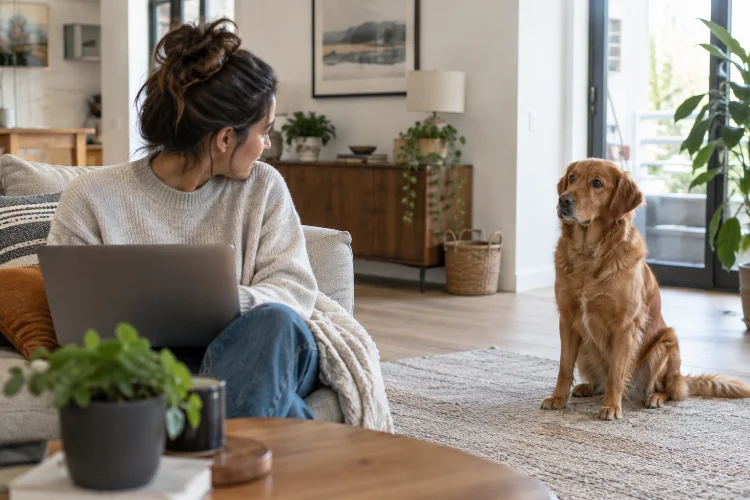
You are sitting on the sofa, working at your desk, or making dinner when you suddenly get that unmistakable feeling that someone is watching you. You turn around, and there is your dog – completely silent, staring directly into your eyes.
So, why does my dog stare at me?
In most cases, the explanation is surprisingly ordinary. Dogs watch humans because we control many of the things that matter to them: meals, walks, toys, doors, attention, and adventures.
They can also use eye contact to communicate, gather information, or simply enjoy interacting with someone they trust. The American Kennel Club notes that dogs frequently watch their owners to understand what may happen next or to communicate something they want.
However, not every stare means the same thing. Soft eyes and relaxed body language tell a very different story from an intense stare accompanied by a stiff posture.
Here is how to understand the difference.
1. Your Dog Is Watching for Clues About What Happens Next
Dogs become incredibly good at learning human routines.
You may think you casually reached for your trainers, but your dog already knows that trainers plus keys often equals walk. Opening a particular cupboard might predict dinner, while picking up a towel could mean bath time.
That is why dogs often stare at their owners before anything exciting has actually happened.
According to the AKC, dogs frequently watch humans to collect information about their environment and anticipate events such as walks, meals, play sessions, and car rides.
Your dog is essentially studying you.
Over time, they may notice incredibly small patterns – where you stand before getting their food, which jacket you wear outside, or what time you normally reach for the leash.
If your dog suddenly becomes intensely interested in you around 5:55 p.m. every day and dinner happens at 6:00, the mystery probably is not very complicated.
2. Your Dog Wants Something From You
Sometimes staring is simply a polite request.
Your dog cannot say, “Excuse me, my water bowl is empty,” so they have to find another communication strategy.
They might stare at you, then look toward the kitchen. They may stare before walking to the door, bringing you a toy, or pawing your leg.
Veterinary behaviourist Dr. Wailani Sung explains that dogs may use eye contact to get attention for food, toilet breaks, play, or other things they want.
Context usually provides the answer.
If your dog stares at you while sitting beside their leash, they probably are not contemplating the meaning of life.
They want a walk.
3. You May Have Accidentally Trained the Staring
Dogs quickly repeat behaviours that produce useful results.
Imagine sitting at the dinner table. Your dog stares at you with enormous hopeful eyes. Eventually, you surrender and give them a small piece of chicken.
Congratulations – you may have just reinforced staring.
The AKC explains that when owners respond to staring by providing food or attention, dogs can learn that watching their humans is an effective strategy for getting what they want.
This is basic learning rather than manipulation in the human sense.
If staring repeatedly earns food, play, petting, or access to something desirable, your dog has every reason to try it again.
If you want to change the behaviour, teach an alternative. For example, your dog could lie on a mat while you eat dinner and receive occasional rewards for remaining there calmly.
4. Your Dog May Simply Enjoy Looking at You
Not every stare is a request.
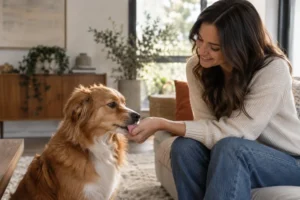
Sometimes dogs appear to make relaxed eye contact simply because they enjoy interacting with their humans.
Research into dog-human relationships has explored the connection between mutual gaze, social bonding, and oxytocin.
Some studies have reported increases in oxytocin associated with positive human-dog interactions and longer mutual gaze, although later research has found more variable results and cautions against oversimplifying the relationship.
In everyday terms, a relaxed gaze between a dog and a trusted owner can be part of normal social bonding.
The important word is relaxed.
Soft eyes, loose facial muscles, comfortable posture, and perhaps a gently wagging tail suggest a very different emotional state from fixed eyes and a rigid body.
So yes, your dog’s stare can sometimes be affectionte – but body language provides the real context.
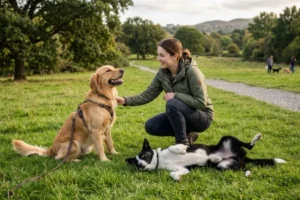
5. Your Dog Is Waiting for a Training Cue
Dogs trained through positive reinforcement often learn to watch their handlers carefully.
Why?
Because paying attention can lead to something rewarding.
A dog may look at you while waiting for “sit,” “come,” “stay,” or another familiar instruction. The AKC notes that dogs trained with reward-based methods can become particularly attentive because human cues predict opportunities to earn treats, toys, or play.
This kind of focus is extremely useful during training.
You can even put eye contact on cue with phrases such as “watch me” or “look.” The goal is not to force prolonged staring but to teach your dog that voluntarily checking in with you can be rewarding.
That skill becomes useful when distractions appear during walks or training sessions.
6. A Hard Stare Can Mean “Give Me Space”
This is where understanding body language becomes important.
A soft stare from your own relaxed dog can be perfectly friendly. A hard, fixed stare from a tense dog can communicate something completely different.
VCA Animal Hospitals explains that direct staring can be part of distance-increasing or aggressive body language. Other signs may include a rigid posture, raised body position, tense facial muscles, or increasingly obvious warning behaviours.
The RSPCA similarly describes an unhappy or defensive dog as potentially showing stiffened posture and intense eye contact alongside other warning signals.
Resource guarding is one situation where this matters.
Imagine approaching a dog that has a valuable bone. The dog suddenly freezes, becomes stiff, and fixes its eyes on you.
Do not interpret that stare as affection.
Give the dog space and avoid attempting to take the object by force. If resource guarding occurs repeatedly, seek help from an appropriately qualified veterinary behaviour professional or reward-based trainer.
7. Why Does My Dog Stare at Me While I Eat?
This may be the easiest canine mystery of all.
Food smells interesting, you are holding it, and your dog knows that humans occasionally drop things.
Dogs also learn quickly whether staring at the table has historically resulted in snacks.
If begging works once every ten meals, that occasional reward can still make the behaviour worth trying.
The simplest solution is consistancy.
Avoid feeding directly from the table if you do not want your dog waiting beside every meal. Instead, give them an alternative activity such as resting on a mat, chewing an appropriate toy, or eating part of their own meal elsewhere.
Family cooperation matters too.
If four people ignore the dog but one person secretly provides sausage, the dog has learned that persistence can still pay.
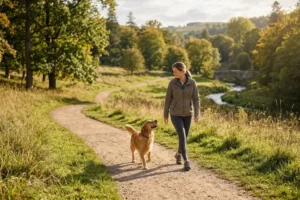
8. Why Does My Dog Stare at Me During Walks?
A dog checking in with you during a walk is often doing something useful.
They might be looking for direction, waiting to see which way you will go, or checking whether a familiar cue is coming.
This behaviour can be encouraged with rewards, particularly if you want your dog to pay attention in distracting environments.
However, context still matters.
A nervous dog may stare at their owner for reassurance when something unfamiliar appears in the enviroment. Another dog may look back before pulling toward an exciting smell.
Watch what happens immediately before and after the eye contact.
Those few seconds often explain more than the stare itself.
9. Should You Stare Back at Your Dog?
Not necessarily.
Many dogs are comfortable making eye contact with people they trust, particularly when they have learned that eye contact predicts rewards or affection.
However, prolonged direct staring can be uncomfortable or threatening to some dogs – especially unfamiliar, fearful, or reactive dogs. The AKC advises avoiding intense staring at unknown dogs and giving space when a dog responds with a stiff posture and unblinking gaze.
Do not approach a strange dog simply because it is looking directly at you.
Instead, observe the entire body.
Loose movements and soft eyes suggest comfort. Tension, freezing, a stiff tail, flattened ears, growling, or hard eyes indicate that you should increase distance.
When interacting with your own dog, allow eye contact to happen naturally rather than physically holding their head or forcing them to look at you.
10. Can Staring Ever Be a Health Concern?
Most staring at an owner is normal behaviour.
However, unusual staring into space, at walls, or at apparently empty areas can occasionally deserve veterinary attention – particularly when it is new or accompanied by other unusual behaviour.
The AKC notes that repeated wall staring can sometimes be associated with neurological problems, including focal seizures, although dogs may also simply be responding to sounds inside walls that humans cannot easily hear.
Sudden behavioural changes in older dogs also deserve attention.
If your dog seems confused, gets stuck in corners, stares repeatedly into space, experiences seizure-like episodes, becomes disoriented, or behaves very differently from normal, contact your veterinarian.
Recording a short video can be helpful because the behaviour may not occur during the appointment.
Occassionally strange behaviour is harmless, but persistent changes are worth investigating rather than assuming they are simply part of aging.
How to Work Out What Your Dog’s Stare Means
Do not interpret the eyes in isolation.
Instead, look at what the entire dog is doing.
Check the ears, mouth, tail, body posture, and movement. Then think about the situation.
Is it almost dinner time? Are you holding a toy? Is someone approaching your dog’s food bowl? Has a stranger entered the house? Are you preparing for a walk?
PetMD recommends considering both the situation and the dog’s overall posture when interpreting staring behaviour. A loose, relaxed dog communicates something very different from a dog that is rigid and tense.
You will probably start recognising patterns surprisingly quickly.
And remeber: sometimes your dog is staring because they want something incredibly sophisticated.
Like the piece of cheese in your hand.
So, why does my dog stare at me? Usually, your dog is gathering information, asking for something, anticipating a familiar activity, waiting for a training cue, or simply engaging with someone they trust.
The meaning becomes clearer when you consider body language and context. Soft eyes and a relaxed body often indicate comfortable social interaction, while a rigid posture and hard stare should be treated as a request for space.
Pay attention to when the staring occurs and what happens immediately afterward. Over time, you will become much better at reading your dog’s individual communication style.
If staring suddenly becomes unusual, repetitive, or accompanied by confusion, seizures, or other behavioural changes, speak with your veterinarian.