

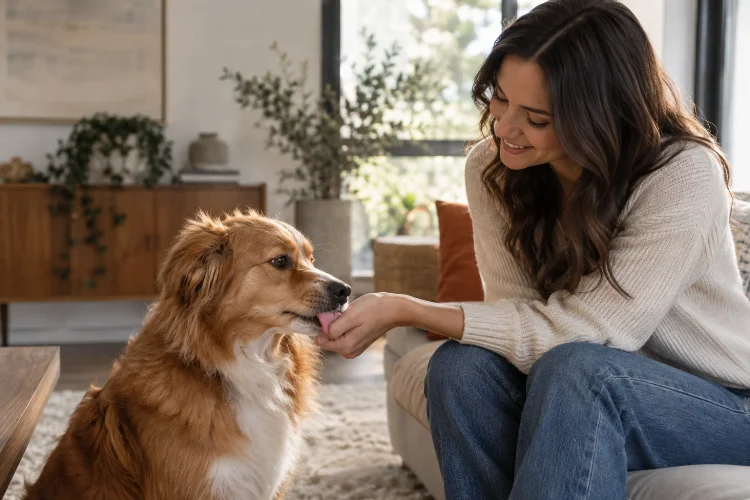
Your dog walks over, looks at you for a second, and suddenly starts covering your hands – or possibly your entire face – with enthusiastic licks. It is easy to interpret this as a canine version of a kiss, but dog licking is actually more complicated than that.
So, why does my dog lick me? Affection can certainly be part of the answer, but dogs also lick people to communicate, seek attention, investigate interesting tastes and smells, groom socially, or calm themselves.
Puppies begin experiencing licking almost immediately after birth, so it is a deeply natural part of canine behaviour.
Most licking is completely normal and harmless. However, a sudden increase in licking or behaviour that becomes obsessive can sometimes point to stress, boredom, pain, or another health problem.
Understanding the context can help you work out what your dog is actually trying to say every time that tongue appears.
1. Your Dog May Be Showing Affection
The simplest explanation may also be one of the most common: your dog likes being close to you.
Dogs often use licking as part of social interaction. Puppies experience licking from their mothers from birth, when mothers clean and care for them. Puppies also lick their littermates, so the behaviour develops naturally as part of early canine life.
As adults, some dogs continue using licking during friendly interactions with humans.
That does not necessarily mean every lick translates directly to “I love you.” Dogs communicate through combinations of body language, movement, facial expression, vocalisations, and behaviour.
However, if your dog approaches with relaxed muscles, a gently wagging tail, and an eagerness to interact, licking can certainly be part of an affectionte greeting.
2. Licking Is an Easy Way to Get Your Attention
Dogs are excellent observers of human behaviour.
Imagine your dog licks your hand while you are working. You immediately look down, smile, scratch behind their ears, and say their name.
Your dog may have just learned something useful: licking makes humans pay attention.
Blue Cross explains that licking can become an attention-seeking behaviour when owners regularly respond with touching, talking, or other interaction.
Even telling your dog to stop may provide attention if attention was what they wanted in the first place.
This does not mean you should ignore your dog all day. Instead, provide attention through walks, training, games, cuddles, and other appropriate interaction rather than allowing persistent licking to become their only reliable way of getting noticed.
3. You Might Simply Taste Interesting
Sometimes the explanation has nothing to do with emotion.
Human skin can be surprisingly interesting to a dog. Sweat contains salts, and your hands may carry traces of food, moisturiser, soap, or countless other smells you barely notice.
Dogs investigate much of their world through scent and taste. PetMD notes that dogs may lick people while exploring smells and flavours, including the salty taste of human skin.
You might notice this most strongly after exercising, cooking, or eating.
If your dog suddenly becomes very interested in licking your fingers after you prepared chicken, they may not be expressing unusually intense love. You probably just smell delicious.
Either explanation is flattering in its own way.
4. Licking Can Be a Social and Grooming Behaviour
Dogs lick themselves as part of normal grooming, and licking can also appear in social interactions.
Mother dogs lick puppies shortly after birth to clean them and provide stimulation. Puppies later lick one another and interact with their mother through licking.
This early history may help explain why licking remains part of communication later in life.
Your dog obviously does not believe you are another puppy. However, behaviours that develop naturally within canine social relationships can also appear during interactions with humans.
Some dogs are simply much more enthusiastic about licking than others.
One dog may greet everyone with a tongue immediately. Another may spend twelve years living happily with the same family and almost never lick anyone.
Both can be perfectly normal.
5. Your Dog May Be Trying to Calm Themselves
Licking can sometimes function as a soothing behaviour.
A nervous dog may lick their lips, themselves, nearby objects, or occasionally another person. PDSA explains that nose licking can appear as part of a dog’s attempts to relieve tension and communicate discomfort.
Context is important here.
If your dog licks you while also keeping their body loose and happily asking for attention, affection or social interaction is more likely.
If licking happens alongside pacing, panting, hiding, yawning, avoiding eye contact, or a tense posture, anxiety may be involved instead.
Look at the entire dog rather than focusing on the tongue alone.
Changes in the enviroment can also matter. Moving house, visitors, fireworks, a new pet, changes in routine, or being left alone can all affect a dog’s emotional state.
6. Why Does My Dog Lick My Face?
Faces are particularly interesting to dogs because they contain plenty of smells and provide immediate social feedback.
There may also be an evolutionary component. Young canids have been observed licking around adults’ mouths in feeding-related interactions, and similar behaviour persists in domestic dogs.
VCA describes puppies licking around their mother’s mouth during the weaning period as part of this behavioural history.
Modern pet dogs are obviously not expecting every human to provide food this way.
For many household dogs, face licking probably combines social interaction, attention-seeking, interesting smells, and learned behaviour.
You also do not have to allow it simply because it is natural.
Blue Cross points out that a dog’s mouth is not particularly hygienic considering everything dogs investigate with it.
If you dislike face licking, calmly redirect your dog toward another behaviour.
7. Why Does My Dog Lick My Hands and Feet?
Hands are basically information centres.
They touch food, furniture, other animals, outdoor surfaces, and countless objects throughout the day. A dog with an excellent sense of smell may discover far more information on your hands than you realise.
Feet can be even more interesting.
They may contain strong human scent and salty perspiration, particularly after wearing shoes all day or exercising. Blue Cross specifically notes that salty post-exercise skin can be attractive to dogs.
Your reaction can then reinforce the habit.
If licking your feet makes you laugh and immediately interact with your dog, they may quickly learn that feet are an excellent button for activating their human.
Dogs are clever like that.
8. When Does Licking Become Excessive?
A few enthusiastic kisses when you arrive home are very different from a dog that seems unable to stop licking.
The AKC notes that excessive licking of people, objects, or the dog’s own body can sometimes be associated with anxiety, boredom, pain, allergies, or other health concerns.
Pay attention to whether the behaviour has changed.
A dog that has always enjoyed licking your hands is less concerning than a dog that suddenly begins licking themselves or household surfaces for hours.
Repeated self-licking deserves particular attention. Dogs may repeatedly target an itchy, painful, or irritated area, potentially making the skin even more inflamed.
If licking seems compulsive, appears suddenly, causes skin damage, interrupts normal activities, or occurs alongside other symptoms, contact your veterinarian.
9. How Can You Reduce Unwanted Licking?
If licking is harmless but you simply do not enjoy it, there is no need to punish your dog.
Punishment can create confusion and may add stress without teaching the dog what you actually want them to do.
Instead, avoid accidentally rewarding excessive licking.
The AKC recommends redirecting dogs toward an alternative behaviour that earns attention, such as performing a familiar cue or engaging in another activity.
For example, when your dog approaches, you could ask for “sit” before offering attention. Over time, sitting politely can replace licking as the behaviour that successfully earns interaction.
Be consistantly boring when unwanted licking starts and much more engaging when your dog chooses the alternative behaviour.
Regular exercise, sniffing opportunities, play, enrichment toys, and short training sessions can also reduce licking that develops primarily from boredom.
10. When Should You Talk to a Vet?
Normal social licking usually does not require veterinary treatment.
The situation changes when licking becomes intense, persistent, or dramatically different from your dog’s normal behaviour.
Contact your veterinarian if your dog repeatedly licks one particular area, develops red or damaged skin, loses hair, seems painful, or suddenly begins compulsively licking people, floors, furniture, or themselves.
Medical issues such as skin irritation, allergies, wounds, pain, nausea, and other problems can sometimes contribute to unusual licking behaviour. AKC notes that persistent licking may warrant investigation when it appears connected to physical or behavioural problems.
Other symptoms matter too.
For example, PDSA notes that lip licking combined with excessive drooling can occur with nausea, dental problems, stress, poisoning, and other conditions.
When in doubt, remeber that a sudden behavioural change is often worth mentioning to your veterinarian.
So, why does my dog lick me? In most cases, licking is simply normal canine behaviour. Your dog may be showing affection, asking for attention, exploring your scent, enjoying the salty taste of your skin, or using a familiar social behaviour learned early in life.
Context provides the best clues. Look at when the licking happens, what your dog was doing beforehand, and what the rest of their body language looks like.
Occassionally, excessive or sudden licking can signal anxiety, boredom, pain, skin problems, or another health concern. If the behaviour becomes compulsive or appears alongside other unusual symptoms, speak with your veterinarian.
Otherwise, those slobbery kisses may simply be one of the many strange ways dogs interact with the humans they enjoy being around.